
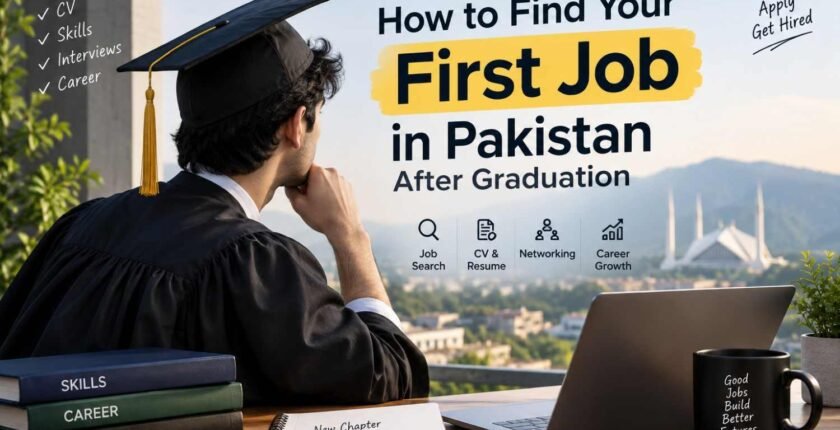
How to Find Your First Job in Pakistan After Graduation
I still remember the exact feeling of walking out of my final exam hall, degree almost in hand, and realizing I had absolutely no plan for what came next. Everyone around me was either talking about CSS exams, MBA admissions, or some cousin’s friend who “knew a guy” in a multinational. Nobody actually sat me down and explained how to find your first job in Pakistan after graduation. I had to figure most of it out the hard way, through rejected applications, awkward interviews, and a few months of pure confusion.
If you are in that same spot right now, staring at your degree and wondering what to do with it, take a breath. This is normal. Almost every graduate in this country goes through the same phase of uncertainty, even the ones who seem to have it all figured out on LinkedIn.
This guide is written the way I wish someone had explained it to me. No corporate jargon, no vague motivational lines. Just what actually works when you are trying to find your first job in Pakistan, and what tends to waste your time.
Why the First Job Search Feels So Hard in Pakistan
Here’s what most people don’t realize before they start applying. The job market in Pakistan is not always about who is most qualified. It is often about who applies smartly, who follows up, and who understands how hiring actually works here.
Many fresh graduates think a good CGPA alone will open doors. In my experience, a good CGPA gets you noticed for maybe five extra seconds. After that, employers want to know what you can actually do. This is especially true in cities like Karachi, Lahore, and Islamabad, where competition for entry level roles is intense because so many universities are producing graduates every single year.
There is also the reality of connections. If you have ever heard someone say “yahan sifarish chalti hai,” you are not wrong, but it is not the whole picture either. Plenty of people land solid jobs purely through applications and interviews. Connections help, but they are not mandatory. Think about it for a moment: someone has to be the first person in their family to get a job without any reference, and that person could be you.
Step One: Get Honest About What You Actually Want
Before you touch a single job portal, sit down and think about the kind of work you can see yourself doing for the next year or two. Not forever, just the next year or two. When someone starts applying to literally everything, from marketing to accounts to customer support, the CV becomes confused and so does the interview.
I have noticed that graduates who target a specific field, even a broad one like sales or content writing, tend to get responses faster than those applying everywhere at once. Recruiters can sense when someone genuinely wants the role versus someone who just wants any job.
Ask yourself these questions honestly.
- What subjects did you actually enjoy in university, not just pass?
- Do you prefer working with numbers, people, words, or systems?
- Are you comfortable in a fast-paced office, or do you want more structure?
You do not need a perfect answer. You just need a direction.
Also read: Best Bank Jobs in Pakistan for Fresh Graduates
Step Two: Build a CV That Actually Gets Read
This is where most fresh graduates lose the game before it even begins. Your CV is not a life story. It is a two-page pitch that either gets you an interview or gets deleted in ten seconds.
One mistake I often see is graduates copying a generic template from the internet and stuffing it with every single activity they have ever done since ninth grade. Nobody hiring for an entry level marketing role in Lahore cares that you won a debate competition in tenth grade, unless you can tie it directly to a skill they need.
Here is what actually works.
Keep it simple and specific. Use clear headings: Education, Experience or Projects, Skills, and maybe a short Objective line at the top that mentions the exact role you want.
Quantify wherever possible. Instead of writing “worked on social media for university society,” write “managed Instagram account that grew from 200 to 1,500 followers in four months.” Numbers catch the eye.
Cut the fluff words. Avoid vague lines like “hardworking and dedicated individual seeking growth opportunities.” Every single CV says this. It means nothing to a recruiter scanning fifty CVs in one sitting.
Tailor it for each application. Yes, this takes more time. But sending the same generic CV to fifty companies almost never works as well as sending twenty CVs that are each slightly adjusted for that specific job description.
If you are unsure how yours looks, ask a senior from your department who already has a job to review it. In my experience, one honest fifteen minute conversation with someone already working can fix mistakes that would have gone unnoticed for months.
Step Three: Use the Right Platforms, the Right Way
Rozee.pk is still the most commonly used job portal in Pakistan, and it genuinely works if you use it correctly. Set up alerts for your target roles, apply within the first day or two of a posting going live, and keep your profile updated with a proper photo and complete work history, even if that history is just internships or projects.
LinkedIn matters more now than it did a few years back, especially for corporate and multinational roles. This usually happens because hiring managers at bigger companies check LinkedIn profiles before shortlisting, even if the application came through email. If your profile picture is a blurry selfie or your headline just says “student,” that is worth fixing today.
Beyond these two, do not ignore:
- Facebook job groups specific to your city or industry, which are surprisingly active for marketing, sales, and customer service roles.
- Company career pages directly, since some organizations do not always post on Rozee or LinkedIn.
- WhatsApp groups run by university alumni or career departments, where openings often get shared before they go public anywhere else.
Step Four: Networking Without Feeling Awkward
I know networking can feel uncomfortable, especially if you are naturally introverted. Many people think networking means shamelessly asking relatives for jobs, and honestly, that discomfort is completely normal. But real networking is simpler than that.
Message people from your university who graduated a year or two before you and are now working in fields you are interested in. Keep it short and respectful. Something like asking about their experience in the industry, or whether their company is hiring, works far better than directly asking “can you get me a job.”
Attend any career fairs, seminars, or alumni events your university organizes. These feel a bit useless at first, but I have seen classmates land interviews simply because they had a five minute conversation with an HR representative at a random career fair booth.
Step Five: Prepare for Interviews Like You Mean It
Getting the interview call is honestly the hardest part. Once you are in the room, or on the video call, do not waste the opportunity by walking in unprepared.
Research the company beforehand. Know what they do, who their competitors are, and why you specifically want to work there. When someone gets asked “why do you want to join us” and stumbles through a vague answer, it shows immediately.
Practice answering common questions out loud, not just in your head. Tell me about yourself. Why should we hire you. Where do you see yourself in a few years. These sound repetitive, but they trip up even smart candidates because thinking an answer and speaking it clearly are two different skills.
Dress appropriately for the role and company culture. A bank interview and a startup interview do not call for the same outfit, and showing up in the wrong tone can quietly work against you before you even speak.
And here is something I wish someone told me earlier: it is completely fine to ask questions at the end of the interview. Asking about growth opportunities or what a typical day looks like shows genuine interest, not desperation.
Common Mistakes That Slow Down the Job Search
Let me walk through a few patterns I have noticed repeatedly among fresh graduates trying to find their first job in Pakistan.
Waiting for the “perfect” job. If he keeps waiting for a role that matches his dream job description exactly, months pass with zero experience gained. Sometimes the smarter move is taking a decent entry level role that builds real skills, then moving up or sideways later.
Applying passively and giving up fast. If she sends out ten applications and hears nothing back within a week, she assumes the whole approach is broken. In reality, this is completely normal. Most graduates apply to thirty, fifty, sometimes over a hundred positions before landing something solid.
Ignoring internships and freelancing. Even unpaid or low paid internships add real value to a CV. Freelancing on platforms like Fiverr or Upwork, even for small projects, shows initiative and gives you something concrete to discuss in interviews.
Not following up. A polite follow-up email a week after applying, or after an interview, shows professionalism. Most candidates never do this, so it genuinely makes you stand out.
What If You Are Struggling to Get Any Response at All
If months have passed with silence, do not assume something is fundamentally wrong with you. This usually happens because of a mismatch somewhere in the process, not because you are unemployable.
Go back and check your CV against actual job descriptions you are applying to. Are you using similar keywords and skills that the posting mentions? Many companies, especially larger ones, filter CVs using basic software before a human ever sees them.
Consider reaching out to smaller companies or startups directly, even without an open posting. A short, genuine email explaining what you can offer sometimes gets more attention than applying into a portal with two hundred other candidates.
And keep building skills in the meantime. Free or low cost courses in Excel, digital marketing, basic coding, or whatever fits your field can fill the gap on your CV and give you something new to talk about in interviews.
Frequently Asked Questions
How long does it usually take to find your first job in Pakistan after graduation? It varies a lot depending on your field, city, and how actively you search. Some graduates land something within a month, others take six months or more. Three to four months of consistent effort is fairly common, so try not to panic if it takes longer than you expected.
Is a good CGPA enough to get hired? Not on its own. It helps you get noticed, especially for roles at bigger companies with strict cutoffs, but employers ultimately care more about your practical skills, communication, and how you handle interview questions.
Should I take an unpaid internship if I cannot find a paying job? If it genuinely offers learning and something to add to your CV, it can be worth it for a limited time, maybe two or three months. Just avoid staying in unpaid roles indefinitely without a clear plan to move forward.
Do connections really matter that much in Pakistan? They can speed things up, but they are not the only path. Plenty of people get hired purely through applications, interviews, and persistence. Focus on what you can control, which is your CV, your skills, and how you present yourself.
Is LinkedIn actually useful in Pakistan, or is it mostly for foreign jobs? It is genuinely useful locally now, especially for corporate, marketing, tech, and multinational roles. Many HR professionals in Pakistan actively use it to find and vet candidates before interviews even happen.
What if my degree does not match the job I want? This is more common than people think. Many successful professionals in Pakistan work in fields unrelated to their original degree. Highlight transferable skills, relevant projects, and any short courses you have completed to bridge that gap.
How many jobs should I apply to before getting worried? There is no fixed number, but do not get discouraged after just five or ten applications. Treat it like a numbers game combined with quality effort. Consistent applying over several weeks usually brings better results than a short burst of ten applications followed by silence.
Is it okay to ask about salary in the first interview? Yes, but timing and tone matter. It is usually better to let the interviewer bring it up first, or ask toward the end once you have shown genuine interest in the role itself.
A Final Thought
Finding your first job in Pakistan after graduation rarely happens the way you imagine it in your final semester. It is messier, slower, and sometimes more frustrating than expected. But every person who is working today, in any field, went through this exact same uncertainty at some point.
Keep refining your CV, keep showing up to interviews even after rejections sting, and keep talking to people in your field. The first job is rarely the perfect one, but it is the one that finally gets your foot in the door. From what I have seen, that is often all you really need.