
Best Skills to Learn for Jobs in 2026: A Practical Guide
Best Skills to Learn for Jobs in 2026
I was talking to a friend last month who has been applying for jobs for almost five months. Same field, same experience level, same polished resume that used to get her interviews without much effort. Nothing. She kept asking me the same question over and over: what changed?
Honestly, a lot changed. Not overnight, but quietly, the way most real shifts happen. Companies aren’t just looking at your job title anymore. They’re looking at what you can actually do and, increasingly, how comfortable you are working alongside tools that didn’t exist in most workplaces a few years ago. If you have ever felt like the ground under your career is moving faster than you can keep up with, you are not imagining it.
This article is not going to give you a generic list copied from a hundred other career blogs. I want to walk you through what is genuinely worth your time this year, why it matters, and how to actually start learning it without burning out or wasting money on courses you will never finish.
Why Skills Matter More Than Job Titles Right Now
Here’s what most people don’t realize. A job title used to be a shortcut. It told an employer roughly what you knew and what you could do. That shortcut is breaking down.
Roles are being reshaped faster than titles can keep up with them. A marketing coordinator today might spend half their week working with AI tools that a marketing coordinator five years ago never touched. A customer support agent might now be expected to manage automated workflows instead of just answering tickets. The title stayed the same. The job did not.
This is exactly why skills-first hiring has become such a common phrase in recruiting circles. Employers are screening for what you can prove, not just what you studied. Portfolios, small projects, certifications, and demonstrated ability now carry weight that a degree alone used to carry on its own.
That does not mean degrees are worthless. It means they are no longer enough by themselves, especially in tech, data, and anything touching artificial intelligence.
Also Read: How to Make a Professional CV for Jobs in Pakistan
The Skills Worth Learning in 2026
1. Working With AI Tools (Not Just Using Them)
I want to be careful here, because this gets misunderstood constantly. Learning AI does not mean becoming a machine learning engineer overnight. Most people do not need that, and honestly, most jobs do not require it either.
What employers actually want is someone who can use AI tools well. That means knowing how to write a prompt that gets a useful result instead of a vague one. It means checking AI output for mistakes instead of copying it blindly. It means understanding where AI genuinely saves time and where it creates more work than it solves.
Think about it for a moment. If two candidates apply for the same role and one can cut a four hour task down to ninety minutes using AI tools responsibly, while the other has never touched them, who do you think gets picked when budgets are tight?
Related roles growing around this include AI workflow specialists, people who test and refine prompts, and staff who train others on responsible AI use inside a company. You don’t need to code to be valuable here. You need judgment, curiosity, and a willingness to experiment.
2. Data Literacy
I have noticed something interesting over the past couple of years. Companies are drowning in data but starving for people who can actually make sense of it. Every click, sale, support ticket, and customer interaction generates information now. Someone has to turn that pile of numbers into a decision.
Data literacy does not mean you need to become a data scientist. It means you can read a chart and understand what it’s actually telling you. It means you can spot when a trend is meaningful and when it’s just noise. A retail manager who understands basic sales data can spot a slow month before it becomes a slow quarter. A hospital administrator who can read patient flow numbers can catch a staffing problem before it turns into a crisis.
If you have never worked with spreadsheets beyond typing in numbers, start there. Learn basic formulas, learn how to build a simple chart, and learn how to ask the right questions of a dataset. That alone puts you ahead of a surprising number of people.
3. Cybersecurity Awareness
When I first started paying attention to hiring trends in tech, cybersecurity felt like a niche specialty reserved for a handful of IT professionals. That is no longer true. Every company with a computer network is a target now, and the demand for people who understand how to protect systems and data has grown steadily.
This does not mean everyone needs to become a penetration tester. Basic cybersecurity awareness is becoming a baseline expectation in many office jobs, the same way basic computer literacy became standard twenty years ago. Knowing how to spot a phishing email, understanding why weak passwords are dangerous, and knowing your company’s data handling rules can genuinely protect you from being the reason a business gets breached.
For anyone wanting to go deeper, cybersecurity remains one of the strongest career paths available, with growth projections that outpace most other tech fields. It pays well, and honestly, there simply are not enough trained people to fill the open roles.
4. Emotional Intelligence and Communication
Many people think soft skills are just a nice bonus on top of technical ability. In my experience, that thinking is backwards. Emotional intelligence has quietly become one of the most valuable skills a person can bring into a workplace, especially as more tasks get automated.
Here’s why. A machine can generate a report, but it cannot read a tense room during a client meeting and adjust its tone. It cannot notice that a teammate is overwhelmed and needs support before a deadline. It cannot build the kind of trust that keeps a team functioning during a hard quarter.
This usually happens because people underestimate how much of work is actually about people, not tasks. If you can communicate clearly, listen without getting defensive, and manage your own reactions under pressure, you become genuinely difficult to replace. That is completely normal to overlook until you watch someone without those skills struggle in a leadership role.
5. Adaptability
If she had told me five years ago that half her job would involve tools that did not exist yet, I doubt she would have believed me. That is the reality a lot of workers are living in now.
Adaptability is not a personality trait you either have or don’t. It’s a habit you build. It looks like being willing to learn a new tool without complaining for two weeks straight. It looks like adjusting your workflow when a process changes instead of quietly resisting it. It looks like staying calm when the plan shifts halfway through a project.
Employers notice this, especially in smaller companies where roles blend together and priorities shift quickly. The people who get promoted are rarely the ones who resist change the loudest. They’re usually the ones who figure out how to work with it.
6. Cloud and Basic Technical Fluency
You do not need to be a software engineer to benefit from understanding how cloud systems work. Most businesses now run on cloud based tools for storage, communication, and daily operations. Understanding the basics, how files are shared, how permissions work, why systems sometimes go down, gives you an edge even outside of technical roles.
If you’re in an operations, admin, or management role and you’ve never touched the settings behind the tools you use every day, that is worth changing. It does not take years. A few focused weeks of learning can make you the person your team turns to when something breaks.
7. Project and Product Management Skills
One mistake I often see is people assuming project management is only for people with “manager” in their title. That is not how it works anymore. Almost every job now involves managing some kind of project, whether that’s a marketing campaign, a product launch, or a simple internal process improvement.
Learning how to break a big goal into smaller steps, track progress, and keep people accountable is a transferable skill that shows up on a resume in almost any industry. It signals to an employer that you can take ownership of outcomes, not just tasks.
A Quick Comparison: Good Habits vs Bad Habits When Upskilling
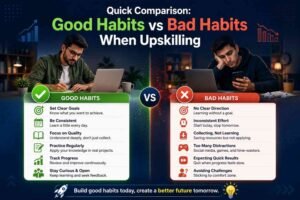
When someone starts trying to learn new skills for the job market, they often make the same mistakes. Signing up for five courses at once and finishing none of them. Chasing whatever skill is trending on social media without checking if it fits their actual career path. Learning in isolation without ever applying the skill to something real.
A better approach looks different. Pick one or two skills that connect to where you already are. Apply what you learn to a small real project, even an unpaid one, so it sticks. Give yourself a realistic timeline instead of expecting mastery in two weeks. That is completely normal, by the way, to need months rather than days.
How to Actually Start Learning These Skills
Imagine this. You decide today that you want to build data literacy. Where do you even begin?
Start small. Free tutorials on spreadsheet basics exist everywhere. Once you’re comfortable, move into a free or low cost course on data analysis fundamentals. Apply what you learn to something in your own life, your household budget, your gym progress, anything with numbers you actually care about.
The same approach works for AI tools, cybersecurity, or project management. Consistency beats intensity every time. Thirty minutes a day for two months will get you further than a single exhausting weekend crash course that you never repeat.
Final Thoughts
If you have ever felt behind in your career because of how quickly things are changing, keep this in mind. Everyone feels that way right now. The people who move forward are not the ones who already know everything. They’re the ones willing to learn a little, apply it, and keep going even when progress feels slow.
Your resume does not need to be perfect. It needs to show that you’re paying attention to where work is heading and doing something about it. That alone puts you ahead of a lot of people who are still waiting for things to go back to the way they used to be.
Frequently Asked Questions
Do I need a college degree to learn these skills? Not necessarily. Many of the skills covered here, like AI tool fluency, data literacy, and communication, can be learned through free resources, short courses, or hands-on practice. A degree can help in certain fields, especially cybersecurity or data science at a senior level, but it is no longer the only path in.
How long does it take to become job-ready in a new skill? It depends on the skill and your starting point, but most people can build a working level of competence in a few months with consistent practice. Mastery takes longer, and that’s fine. Employers usually care more about your ability to apply a skill than perfect it.
Is learning AI tools actually necessary if I’m not in tech? Yes, in most cases. AI tools are showing up in marketing, healthcare administration, customer service, education, and countless other fields outside of tech. You don’t need advanced technical knowledge, just enough comfort to use these tools effectively in your own work.
What if I don’t have time to learn new skills while working full time? Start with short, consistent sessions instead of trying to carve out huge blocks of time. Even fifteen to twenty minutes a day adds up over a few months. Pick one skill at a time instead of trying to learn everything at once.
Are soft skills really as valuable as technical skills? In many cases, yes. Technical skills get you noticed, but soft skills like communication and emotional intelligence often decide who gets promoted, who gets trusted with bigger projects, and who stays employed during layoffs.
Which skill should I prioritize first? Start with whatever connects most directly to your current job or industry. If you work with data already, deepen your data literacy. If you’re in a client-facing role, focus on communication and AI tool fluency. Building on what you already do makes the learning stick faster.
Will these skills still matter in a few years? The specific tools will change, they always do, but the underlying skills, adaptability, data thinking, clear communication, and comfort with technology, tend to stay relevant far longer than any single trend. Learning how to learn is honestly the most durable skill of all.
Is it too late to start if I’m already mid-career? Not at all. In my experience, mid-career professionals often adapt faster because they already understand how to apply new knowledge to real problems. Starting later just means being intentional about where you focus your time.
Continue using AI Cursor?Keep it onTurn Off