

NTS Test Preparation Tips 2026: Free Guide to Score High
NTS Test Preparation Tips
I remember sitting outside the exam hall for my first NTS test, watching people flip through thick guidebooks like they were trying to memorize an entire library in ten minutes. If you are also struggling with NTS test preparation, here are real, practical NTS test preparation tips from someone who has been through it, so you can walk in ready and score high. I had done the same thing the night before, and honestly, none of it stuck. That was the moment I realized something most people don’t figure out until after they’ve already failed once: the NTS test preparation doesn’t reward last-minute cramming. It rewards preparation that’s spread out, focused, and a little bit strategic.
If you’re reading this because your test date is coming up and you’re not sure where to start, take a breath. You don’t need to read everything ever written about the NTS. You need a plan that actually matches how the test is built. That’s what this guide is for.
What the NTS Test Actually Checks
Many people think the NTS test is just another general knowledge quiz. It isn’t. Depending on which NTS test you’re taking, whether it’s the NAT, GAT, or a specific subject test, the paper usually checks four broad areas: verbal reasoning, quantitative or math ability, analytical reasoning, and general knowledge or subject-specific content.
Here’s what most people don’t realize. These sections aren’t testing how much you’ve memorized. They’re testing how quickly and accurately you can think under pressure. That’s a different skill than school exams, and it needs a different kind of practice.
Start With the Syllabus, Not the Guidebook
One mistake I often see while doing NTS test preparation is that students buying a 500-page guidebook and starting from page one without checking whether half of it is even relevant to their test. Before you touch any book, look up the official NTS syllabus for your specific test category. NAT-IM, NAT-ICS, GAT General, and subject tests all have different weightage for different sections.
Once you know the breakdown, say 20 marks for English, 20 for quantitative, 20 for analytical, and 40 for your subject, you can decide how much time each section deserves. If your subject knowledge is already strong from your degree, you don’t need to spend three weeks re-learning it. Spend that time instead on the sections where you’re weak.
Build a Weekly Study Plan That You Can Actually Follow
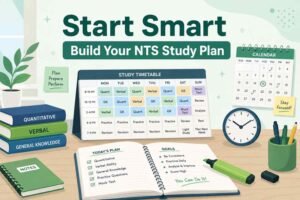
I’ve noticed that most students make study plans for NTS test preparation that look great on paper and fall apart by day three. The plan says “study eight hours daily,” and by the second day, that turns into forty-five minutes of scrolling through your phone with a book open next to you.
A better approach is to plan around what you can realistically manage. If you have six weeks before your test, break it down like this:
- Week 1 and 2: Go through concepts you’re weak in, section by section.
- Week 3 and 4: Start solving past papers under a timer.
- Week 5: Focus only on your weak areas identified from past paper mistakes.
- Week 6: Light revision, full-length mock tests, and rest.
Notice that revision comes at the end, not throughout. That’s intentional. When you revise something you already half-know, right before the test, it stays fresher in your memory.
Past Papers Are Not Optional
If you take away one thing from this article, let it be this. Past papers are the single most useful resource for NTS test preparation, and most students underuse them. They don’t just show you what kind of questions to expect. They show you the pattern of thinking the test wants from you.
When someone starts solving past papers only in the last few days before the exam, they usually run out of time to fix the mistakes they find. Instead, start solving one past paper a week from early on, then increase to two or three papers a week as your test date gets closer. Time yourself exactly like it’s the real exam. No pausing to check your phone. No looking up answers halfway through.
After each paper, go through every wrong answer and understand why you got it wrong. Was it a concept issue? A silly calculation mistake? Running out of time? Each of these needs a different fix.
English and Verbal Section: What Actually Helps
Let me explain something that trips up a lot of test-takers. The English section on the NTS test isn’t about knowing fancy vocabulary. It’s about grammar rules, sentence correction, analogies, and reading comprehension under time pressure.
In my experience, the fastest way to improve here is daily reading, even just fifteen minutes of a newspaper editorial or a well-written article. This naturally builds your sense of sentence structure, which helps far more than memorizing word lists. For grammar-specific rules like subject-verb agreement, tenses, and prepositions, a focused grammar workbook works better than a general vocabulary list.
Quantitative Section: Speed Over Complexity
Think about it for a moment. The math questions on the NTS test are not advanced. They’re based on percentages, ratios, basic algebra, averages, and simple geometry. The challenge isn’t the difficulty of the math. It’s doing it fast enough within the time limit.
This usually happens because students solve problems the long way, the way they were taught in school, instead of learning shortcut techniques. Learning a handful of quick calculation tricks, like estimating percentages or solving ratio problems without long division, can save you real time on test day.
Analytical Reasoning: Practice Pattern Recognition
Analytical questions, things like series completion, logical deduction, or figure-based puzzles, feel intimidating at first. That’s completely normal. Nobody solves these instantly on their first attempt.
What helps is repeated exposure. The more analytical puzzles you solve, even ones unrelated to NTS specifically, the more your brain starts recognizing patterns quickly. Puzzle books, logic games, and even certain mobile apps built for reasoning practice can genuinely help here, not as a replacement for NTS-specific practice, but as a supplement.
Good Practice vs Bad Practice

If you have ever wondered why two students who studied the same number of hours get very different scores, this is usually why.
Bad practice looks like reading a chapter, nodding along, and moving to the next one without testing yourself. Good practice looks like reading a chapter, closing the book, and trying to answer questions on it without looking. One creates the illusion of learning. The other creates actual recall.
Bad practice also looks like solving only easy questions to feel good about your progress. Good practice means deliberately attempting the questions you find hardest, because those are the ones costing you marks.
Taking Care of Yourself Before Test Day
This part gets skipped a lot, but it matters more than people admit. From what I have seen, students who pull all-nighters right before the test often perform worse than students who studied less overall but slept properly.
In the final three days before your test, cut back on adding new material. Focus on light revision, practice one timed mock test, and prioritize sleep. Your brain consolidates memory during sleep, so cramming at 2 AM the night before actually works against you, not for it.
On Test Day Itself
Get to the test center early. Bring your admit card, a valid ID, and extra pens, since these small details cause unnecessary panic when forgotten. When the test starts, don’t dive straight into question one and grind through it if it’s hard. Skim the paper first if allowed, answer the questions you’re confident about, and come back to the harder ones later. This protects your time and your confidence.
If you hit a question you genuinely don’t know, don’t freeze on it. Mark it, move on, and come back only if time allows. One tough question shouldn’t cost you three easy ones later in the paper because you ran out of time.
FAQs About NTS Test Preparation
How many hours should I study daily for the NTS test preparation test?
There’s no fixed number that works for everyone. What matters more is consistency. Two to three focused hours daily for six weeks will usually beat eight scattered hours crammed into the final week.
Are NTS past papers enough to pass the test?
Past papers are essential, but they work best alongside concept review. Use past papers to identify weak areas, then go back to your books or notes to fix those specific gaps.
What is a good score to aim for in the NTS test?
This depends on the specific test and the competition for that particular post or program. As a general guide, aiming for 70 percent or higher gives you a safer margin in most NTS test categories.
Should I focus more on my weak sections or my strong sections?
Weak sections deserve more of your study time since that’s where the biggest score improvements usually come from. Just don’t ignore your strong sections completely, since a little maintenance keeps them sharp.
Is negative marking applied in the NTS test?
This varies depending on the specific test category, so check the instructions on your admit card or the official NTS notice for your test. When in doubt, avoid guessing randomly on question types where negative marking applies.
How close to the test date should I stop studying new material?
Around three days before the test is a reasonable cutoff for new material. Use those final days for light revision and rest instead.
Can I prepare for the NTS test without coaching classes?
Yes, plenty of people prepare successfully on their own using past papers, official syllabus documents, and structured self-study. Coaching can help if you struggle with discipline or need explanations for specific concepts, but it isn’t mandatory for a good score.
What should I do if I run out of time during the actual test?
Answer every question you can, even with a quick guess if there’s no negative marking, since an unanswered question guarantees zero marks. Prioritize sections you’re strongest in first so your best work gets done regardless of time pressure.
A Final Thought
If there’s one thing I’d want you to remember about NTS test preparation, it’s that the NTS test rewards preparation that’s honest about your weak spots, not preparation that just feels productive. Track your mistakes, fix them one at a time, and give yourself enough rest before the test to actually use what you’ve learned. That’s really what separates a good score from an average one, and it’s something anyone can do with the right plan and a bit of patience. Also don’t forget to explore our website for such helpful content.